A photo and a verdict for every door
Every door photographed with a plain pass/fail against current standards — no sampling gaps, so your evidence covers the whole school site rather than a percentage of it, ready for the compliance file.
Independent, impartial fire door inspections for schools, academies and colleges — every door photographed when pupils are off site (holidays, INSET days or weekends), with clear records for your governors or trust. Independent, so I don’t sell, fit or repair the doors I inspect.
Under the Regulatory Reform (Fire Safety) Order 2005, a school is non-domestic premises and the responsible person — usually the academy trust, governing board or local authority as employer — must keep fire doors in efficient working order and good repair. The Order sets no fixed interval, so checks must be frequent enough to keep doors reliably safe, and the DfE’s Good Estate Management for Schools guidance expects planned, preventative maintenance and statutory compliance checks that cover fire doors. General information, not legal advice.
For an estates lead, school business manager or trust compliance officer, that duty is a continuing one rather than a once-a-year event. A school is non-domestic premises under the Fire Safety Order 2005, and the responsible person must keep every fire door across the site in efficient working order and good repair. Because the Order sets no fixed interval, checks simply have to be frequent enough to keep the doors reliably safe — in practice a professional inspection alongside routine in-house visual checks.
Who the responsible person is depends on the school type: the academy trust for academies and free schools, the governing board for foundation and voluntary-aided schools, and the local authority as employer for community and voluntary-controlled schools. Whoever holds the duty, the DfE’s Good Estate Management for Schools guidance expects planned, preventative maintenance and statutory compliance checks, and a dated photographic inspection is exactly the kind of evidence that stands up to governors, trustees and enforcing officers.
Regulation 10 of the Fire Safety (England) Regulations 2022 applies only to residential buildings over 11 metres containing two or more homes — high-rise blocks of flats — so it very rarely affects a school estate. The school’s duty across the site is the Fire Safety Order 2005. If any part of your site is genuinely high-rise residential, I can help you check whether Regulation 10 applies.
Want the rules in plain English?
Read my jargon-free guide to the Fire Safety Order and fire door duties to see exactly what applies across your school estate.
Every door photographed with a plain pass/fail against current standards — no sampling gaps, so your evidence covers the whole school site rather than a percentage of it, ready for the compliance file.
Each defect is located and priority-graded, so a stretched estates budget can hit what genuinely matters first and plan the rest — with plain-English remedial recommendations for your own contractors.
A consistent door-by-door register so you can track remedials and re-inspection across the site, and roll findings up for governors, a trust estates team, your FRA, insurers or an enforcing officer.
Aligned to BS 8214:2026, the UK code of practice for fire doors — and written so you can hand it to governors, trustees or an enforcing officer without editing it first.
PDF · opens in a new tab
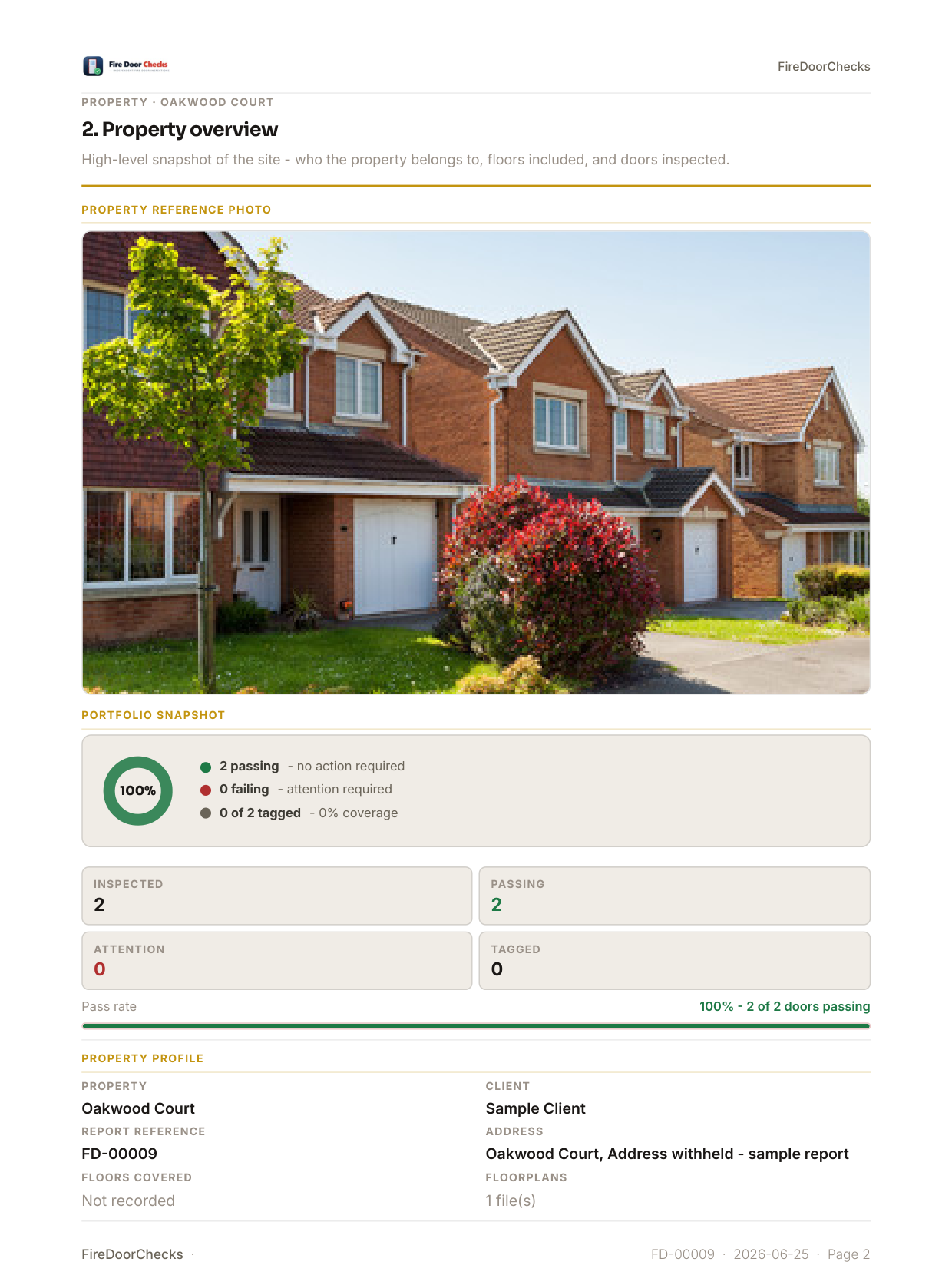
Every door is photographed, so inspections are carried out when pupils are off site — during the holidays, on INSET days or at weekends — agreed in advance to fit your calendar. That keeps children out of the photographic record and disruption to a minimum.
Because every door is photographed, I can’t guarantee children would be out of shot — so the inspection is scheduled for when pupils are off site. For any staff on site I follow your visitor sign-in and safeguarding procedures throughout, working methodically and unobtrusively.
A multi-building school or a split site is covered to the same standard throughout and delivered as one consolidated report with a door-by-door register — one inspector for consistency block-to-block and year-on-year.
For a multi-academy trust, inspections can be set on a recurring, multi-site programme so records stay current and the cost is predictable to budget for year on year, across every school in the trust.
Use the instant estimator or send a message with your buildings, rough door count and access notes. I’ll confirm a per-door price and a plan for the visit — no obligation.
I inspect and photograph every door in scope — carried out when pupils are off site, on INSET days, half-term or the holidays — following your visitor sign-in and safeguarding procedures for any staff on site.
You get a detailed photographic report typically within around 48 hours — a status for every door, priority-graded defects and a prioritised remedial list for your compliance file.
You pay a simple per-door rate, with the rate tapering as the door count rises — so a larger school site or a whole trust pays less per door — plus one clear, drive-time travel call-out and nothing hidden. Every school or trust portfolio gets a firm, no-obligation quote.
I don’t sell, fit or repair the doors I inspect, so there’s no incentive to over-report to win remedial work. That impartiality protects a stretched estates budget from unnecessary spend — a fail is an honest safety finding, not a sales pitch.
More than seven years in fire safety and a working knowledge of the BS 8214:2026 code of practice, applied consistently across every door and every visit by one inspector, first contact to report.
Reports are formatted for the people who’ll read them — governors, trust estates teams, responsible persons, fire risk assessors, insurers and enforcing officers — calm, factual and in plain English.
During the school holidays, on INSET days, or at weekends and out of hours. Every door is photographed and children can’t be guaranteed out of shot, so for safeguarding the inspection is carried out when pupils are off site. It’s agreed in advance to fit your calendar.
Usually the employer: the academy trust for academies and free schools, the governing board for foundation and voluntary-aided schools, or the local authority for community and voluntary-controlled schools. General information, not legal advice.
There is no fixed statutory interval. Many schools arrange a professional inspection annually alongside routine in-house checks, in line with the fire risk assessment and DfE estate guidance. General information, not legal advice.
Almost never. Regulation 10 applies to residential buildings over 11 metres containing two or more homes (high-rise blocks of flats); a school’s duty across the site is the Fire Safety Order 2005. If any part of your site is genuinely high-rise residential, I can help check whether it applies. General information, not legal advice.
Yes. A multi-building school or a split site is covered in one consolidated report with a door-by-door register for the governing board or trust.
No. The inspection is scheduled for when pupils are off site — the holidays, INSET days or weekends — so there’s no disruption to lessons and the photographic record never risks capturing children. For any staff on site I follow your visitor sign-in and safeguarding procedures.
A detailed photographic report: every door photographed with a plain pass/fail, defects priority-graded, and a prioritised remedial list. Typically within around 48 hours.
No — deliberately. I inspect and report only, so the assessment stays impartial. You act on it with your own contractors, working from a clear, prioritised scope.
Get started
Get an instant indicative price, or send a few details and I’ll come back with a firm, no-obligation quote — carried out when pupils are off site, during the holidays, on INSET days or at weekends.
If you also look after care settings or leasehold blocks, there’s a page written for each — or explore where I work across the South West.