Offices & business parks
Single offices, multi-let floors and business parks — corridor, stairwell, riser, plant-room and final-exit fire doors checked and recorded across the whole floor plate.
Impartial surveys and clear photographic reports for offices, shops, warehouses and industrial units — evidence for your fire risk assessment, insurers and enforcing officers, with minimal disruption to trading, across single or multiple sites. Independent, so I don’t sell, fit or repair the doors I inspect.
Under the Regulatory Reform (Fire Safety) Order 2005, the responsible person for non-domestic premises must keep fire doors and other fire precautions in efficient working order and good repair. The Order sets no fixed inspection interval, but a documented, competent inspection — commonly every 6 to 12 months — supports your fire risk assessment and provides the recorded evidence insurers and enforcing officers expect. General information, not legal advice.
If you own, occupy or manage commercial premises, someone is the responsible person for fire safety — often a facilities manager, owner or occupier. Keeping fire doors in efficient working order and good repair is a continuing duty, not a one-off task, and it applies across virtually all non-domestic premises.
A fire door only works as a complete assembly: the leaf, the frame, the gaps and clearances, the intumescent and smoke seals, the hinges, the self-closer, the glazing and the signage all have to be right together. Because there is no fixed statutory interval, checks simply have to be frequent enough to keep every door reliably safe — and a documented inspection every 6 to 12 months is widely treated as good practice.
An independent inspection turns that duty into a competent, dated record you can put in front of your fire risk assessor, your insurer and the local Fire and Rescue Authority, rather than relying on an untested assumption that the doors are fine.
Want the rules in plain English?
Read my jargon-free guide to the Fire Safety Order and fire door duties to see exactly what applies to your premises.
Single offices, multi-let floors and business parks — corridor, stairwell, riser, plant-room and final-exit fire doors checked and recorded across the whole floor plate.
Shops, showrooms, restaurants, bars, gyms and salons — front-of-house and back-of-house doors alike, worked around trading so the customer experience isn’t disturbed.
Office fit-outs, mess and plant rooms and higher-risk separation within warehouses, factories and industrial units — each compartment door assessed on its own merits.
Where landlord and tenant responsibilities overlap, I inspect and report clearly on the doors in scope — single sites or a portfolio to the same standard, one combined report or a report per site.
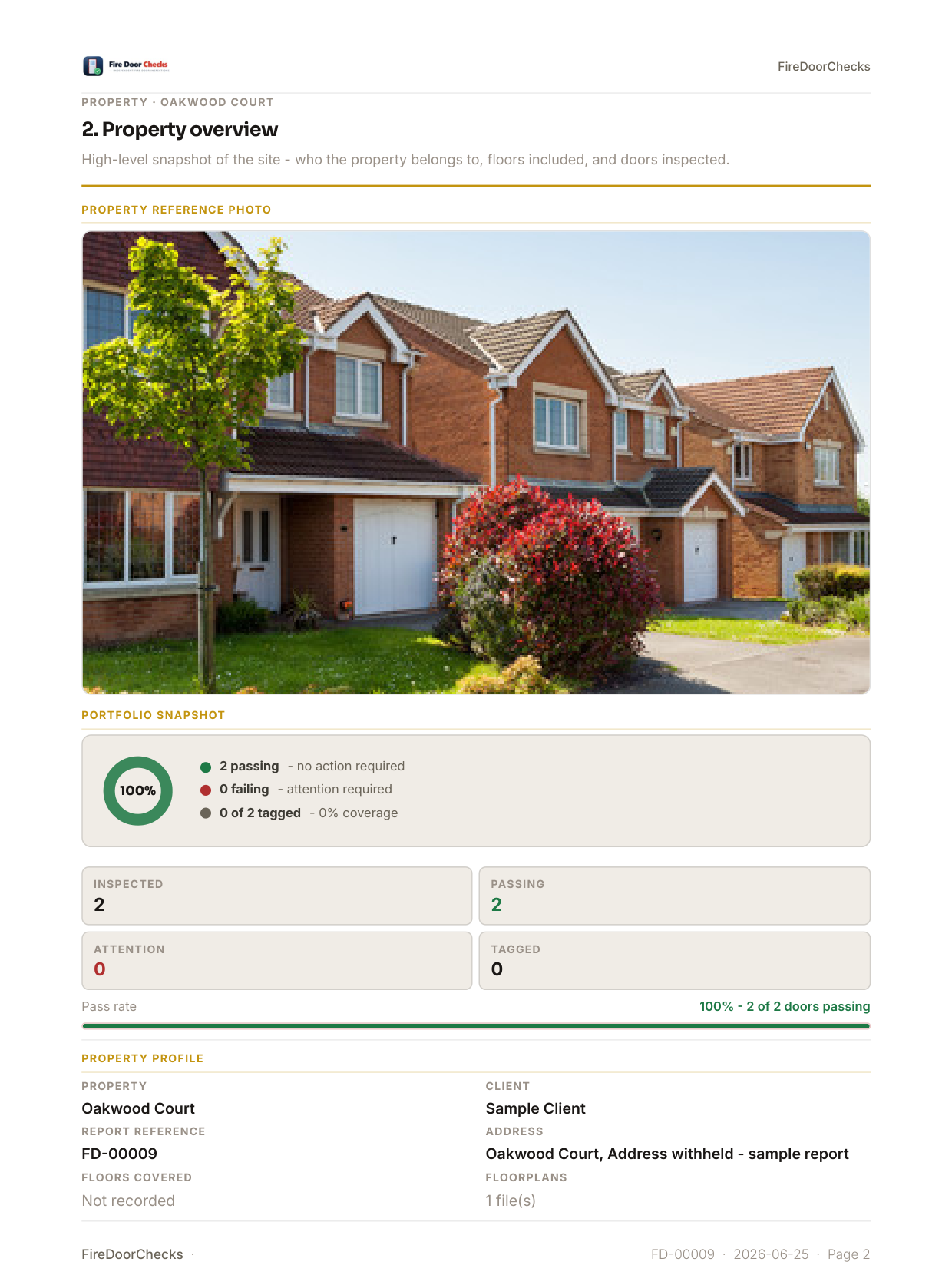
A detailed report with every door numbered and photographed and a clear pass/fail — no sampling gaps, so your evidence covers the whole premises, not a percentage of it.
Each defect is located and priority-graded, assessed against BS 8214:2026, so your team and your contractor know what genuinely matters first and what can wait.
A priority-graded remedial schedule you can hand straight to whichever competent contractor you choose — formatted for responsible persons, FMs, fire risk assessors, insurers and enforcing officers, typically within ~48 hours.
Aligned to BS 8214:2026, the UK code of practice for fire doors — and written so you can hand it to your fire risk assessor, your insurer or an enforcing officer without editing it first.
PDF · opens in a new tab
Use the instant estimator or send a few details about your site or sites — rough door counts and access notes. I’ll confirm a per-door price and a plan, with no obligation.
I inspect and photograph every door as a complete assembly, scheduled around your trading hours — early, late or phased, room by room — with multi-site work coordinated around your operational calendar.
You get a detailed photographic report typically within around 48 hours — a per-door record with pass/fail and prioritised remedials, ready for your fire risk assessment or compliance file.
Your fire risk assessment relies on the doors actually being maintained. An independent survey gives the door-by-door detail behind that assumption, so the FRA rests on evidence rather than hope.
Insurers increasingly ask for maintenance evidence, and a dated photographic pass/fail record is exactly that. Note: I provide inspection evidence only; I do not provide or arrange insurance.
If an enforcing officer or auditor asks how you know your doors are safe, a competent, documented inspection answers the question — and independence means there’s no commercial bias behind the findings.
You pay a simple per-door rate that drops as the door count rises across your premises or portfolio, plus one clear, transparent drive-time travel call-out — and every commercial building or portfolio gets a firm, no-obligation quote up front.
I don’t sell, fit or repair the doors I inspect, so a fail is always a genuine safety finding rather than a route to selling you a door. You keep full control of any remedial work.
More than seven years in fire safety and a working knowledge of the BS 8214:2026 code of practice, applied consistently across every door and every visit, by one inspector start to finish.
Reports are formatted for the people who’ll read them — responsible persons, facilities managers, fire risk assessors, insurers and enforcing officers — calm, factual and in plain English.
Under the Fire Safety Order 2005 the responsible person must keep fire doors in efficient working order and good repair. There’s no fixed interval, but a documented, competent inspection every 6 to 12 months is good practice and the clearest evidence you’re meeting the duty. General information, not legal advice.
No. These are visual door-by-door checks that can be scheduled around your trading hours — early, late or phased, room by room — and multi-site work is coordinated to minimise downtime.
Yes. You can have one combined report or a separate report per site, whichever suits your records. Larger volumes attract a lower per-door rate.
A detailed photographic report with every door numbered and photographed, a plain pass/fail and priority-graded defects, assessed against BS 8214:2026. It supports your fire risk assessment and gives insurers and enforcing officers the recorded evidence they expect. Note: I provide inspection evidence only; I do not provide or arrange insurance.
A per-door rate from around £15 that tapers as the door count rises, plus one transparent drive-time call-out (£45 up to 30 minutes, then £15 per extra 15 minutes). Use the estimator at /quote for an instant figure.
No — deliberately. I inspect and report only, so a fail is always a genuine safety finding rather than a route to selling you a door. You keep control of remedial work and use your own contractor.
Typically within around 48 hours: a per-door photographic record with pass/fail and priority-graded defects.
Virtually all non-domestic premises. If you own, occupy or manage them, at least one person is the responsible person with a duty to keep fire doors maintained in efficient working order. General information, not legal advice.
Get started
Get an instant indicative price, or send a few site details and I’ll come back with a firm, no-obligation quote for a single site or a multi-site programme.
If you also look after managed blocks, hotels or care settings, there’s a page written for each — or explore where I work across the South West.