A photo and a verdict for every door
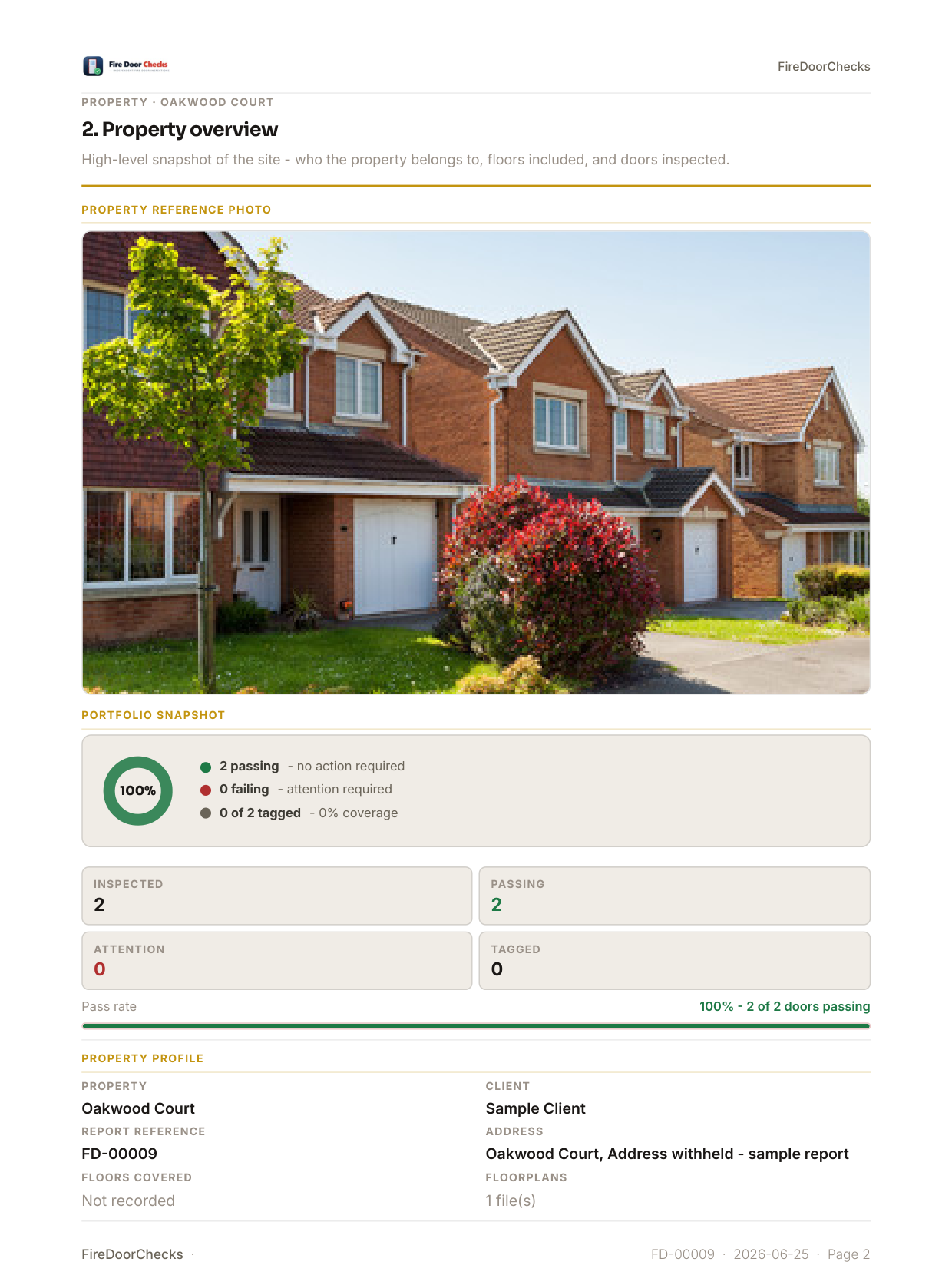
A BS 8214:2026-aligned photographic report with a photo and a plain pass/fail for every door — no sampling gaps, so the evidence covers the whole site, not a percentage of it.
Independent, impartial door surveys and clear photographic reports — multi-site coordination for facilities and estates teams, and a subcontracted specialist survey that feeds a fire risk assessor’s assessment. I inspect doors only, so I don’t sell, fit or repair them — and I don’t compete for your FRA work.
Under the Regulatory Reform (Fire Safety) Order 2005, the responsible person for non-domestic premises must keep fire doors in efficient working order and good repair. The Order sets no fixed interval, but a documented, competent inspection — commonly every 6 to 12 months — supports the fire risk assessment and gives the recorded evidence insurers and enforcing officers expect. A suitable and sufficient fire risk assessment must consider the condition of fire doors and compartmentation, but a general assessment does not always include a detailed door-by-door survey. General information, not legal advice.
For a facilities or estates manager, that duty lands as a steady, portfolio-wide need for current, credible evidence — across offices, industrial units, retail and mixed-use sites that may sit under one budget but a dozen different roofs. A door works only as a complete assembly, and a documented inspection turns the maintenance duty into a dated, photographic record you can put before your FRA, your insurer and the local Fire and Rescue Authority.
For a fire risk assessor, the same survey fills a specific gap. Your assessment has to consider door condition, but the general FRA scope often stops short of opening, measuring and photographing every leaf, gap and seal. Where you need a competent, documented door inspection to inform or support an assessment, a specialist survey supplies that detail — delivered in a format that slots straight into your report, with a plain, unbranded presentation on request.
Because I inspect doors and nothing else, there’s no conflict either way: I don’t sell, fit or repair the doors I survey, and I don’t carry out fire risk assessments. Your client — and your remedial budget — stays entirely yours.
Want the rules in plain English?
Read my jargon-free guide to the Fire Safety Order and fire door duties to see exactly what applies to the premises you look after.
A BS 8214:2026-aligned photographic report with a photo and a plain pass/fail for every door — no sampling gaps, so the evidence covers the whole site, not a percentage of it.
Each defect is located and priority-graded, with plain-English remedial recommendations — so you, your contractors or your client know what genuinely matters first and what can wait.
A consistent per-door reference system, delivered digitally — ready to roll into a CAFM or asset system, reference in a fire risk assessment, or present plain and unbranded for your own report.
Aligned to BS 8214:2026, the UK code of practice for fire doors — and written so you can hand it to your client, your fire risk assessor or an enforcing officer without editing it first.
PDF · opens in a new tab
Single site or a portfolio under one budget, the same methodology and grading is applied throughout — one inspector and one point of contact, with visits planned around your operational calendar and one combined report or a report per site as you prefer.
For fire risk assessors, a subcontracted door-by-door survey that fills the gap a general FRA leaves — every door opened, measured, photographed and graded, delivered in a format that references cleanly in or attaches to your assessment.
I inspect doors and nothing else — I don’t sell, fit or repair them, and I don’t carry out fire risk assessments. So there’s no incentive to over-report, and no risk of a subcontractor poaching your assessment work. Your client stays yours.
Set a scheduled inspection cycle so evidence stays current across the estate, or a standing referral arrangement so door surveys are on tap whenever an assessment needs one — consistent methodology every time.
Use the instant estimator or send a message with your sites, rough door counts and access notes — or, if you’re an assessor, the site you need surveyed. I’ll confirm a per-door price and a plan — no obligation.
I inspect and photograph every door in scope, scheduled around trading and operational hours to keep disruption to a minimum, checking each as a complete assembly and grading anything I find.
You get a report typically within around 48 hours — a per-door photographic record with pass/fail and prioritised remedials, ready for your compliance file, your CAFM system or your fire risk assessment.
You pay per door, with the rate tapering as the count rises across a single site or a whole portfolio, plus one clear drive-time travel call-out — and every facilities team or fire risk assessor gets a firm, no-obligation quote before anything is booked.
I don’t sell, fit or repair the doors I inspect, and I don’t carry out fire risk assessments. So there’s no incentive to over-report to win remedial work, and no risk of a subcontractor competing for your assessment.
More than seven years in fire safety and a working knowledge of the BS 8214:2026 code of practice, applied consistently across every door and every visit.
Reports are formatted for the people who’ll read them — responsible persons, facilities and estates leads, fire risk assessors, insurers and enforcing officers — calm, factual and in plain English.
Yes. I plan the programme around your operational calendar, with one point of contact and one methodology applied site-to-site. You can have one combined report or a separate report per site, quoted in a single go.
Yes. A suitable and sufficient fire risk assessment must consider the condition of fire doors, but a general assessment does not always include a detailed door-by-door survey. I provide a competent, documented door inspection you can reference in or attach to your assessment. General information, not legal advice.
No. I inspect fire doors only — I don’t carry out fire risk assessments, so I’m not competing for your core work. Your client stays yours; I simply supply the specialist door survey you brief me on.
Yes. A plain, unbranded presentation is available on request so the survey drops cleanly into your own assessment report or your client’s compliance file.
The Fire Safety Order 2005 sets no fixed interval, but a documented, competent inspection — commonly every 6 to 12 months — supports the fire risk assessment and provides the recorded evidence insurers and enforcing officers expect. Your assessment may point to a more frequent cycle. General information, not legal advice.
No — and that’s the point. I provide an impartial assessment and a priority-graded defect list for whichever competent contractor you or your client chooses to appoint, so a fail is always a genuine safety finding, not a route to selling work.
Per door, tapering with volume, plus one transparent drive-time call-out from £45. Use the estimator for an instant figure, then I refine it into a multi-site programme or a referral arrangement with a firm, no-obligation quote.
Typically within around 48 hours: a per-door photographic record with pass/fail and priority-graded defects, ready to slot into your compliance file or your assessment.
Get started
Get an instant indicative price, or send a few details — your sites and door counts, or the assessment you need a survey for — and I’ll come back with a firm, no-obligation quote.
If you also look after commercial premises, leasehold blocks or education sites, there’s a page written for each — or explore where I work across the South West.