Every door photographed & numbered
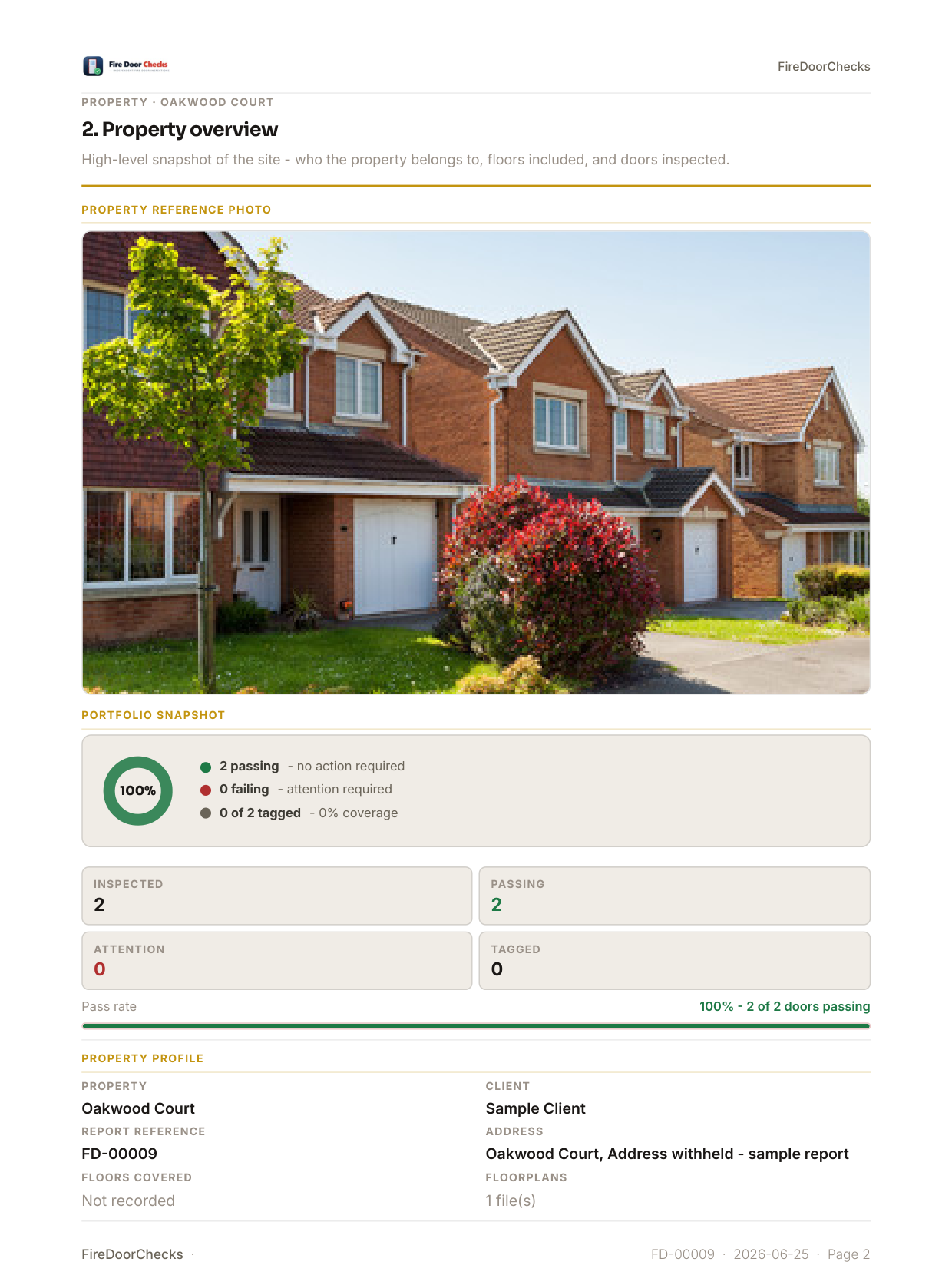
A BS 8214:2026-aligned photographic report with every fire door numbered and photographed, and a plain pass/fail for each — a tidy digital record, not a percentage sample.
Independent, impartial fire door inspections and photographic reports for private landlords, HMO operators and portfolios across Devon and the South West — the recorded evidence you need for your HMO licence, your council or fire officer, and your tenants’ safety.
For HMOs, your duties come from the Housing Act 2004 and The Management of Houses in Multiple Occupation (England) Regulations 2006 — regulation 4 requires the fire safety measures protecting means of escape, including fire doors, to be maintained in good order and repair. The common parts of HMOs and blocks of flats also fall under the Regulatory Reform (Fire Safety) Order 2005, and LACORS fire safety guidance is the benchmark councils and fire officers apply, expecting fire doors on escape routes to be sound, well-fitting and, where required, self-closing. General information, not legal advice.
There is no fixed statutory interval for a professional inspection, but the duty to keep those doors in good order is a continuing one — and the clearest way to evidence it is a competent, dated, photographic record. An independent inspection turns that legal duty into documented evidence you can put in front of a licensing officer, a fire officer or an insurer.
Regulation 10 of the Fire Safety (England) Regulations 2022 — the quarterly communal-door and annual flat-entrance checks — applies only to blocks of flats over 11 metres. That is relevant to some portfolio landlords, but not to a typical single-house HMO. If you own a taller residential block, I can carry out and record those checks too.
Want the rules in plain English?
Read my jargon-free guide to the Fire Safety Order and HMO fire door duties to see exactly what applies to your property.
A BS 8214:2026-aligned photographic report with every fire door numbered and photographed, and a plain pass/fail for each — a tidy digital record, not a percentage sample.
Notes on gaps and clearances, intumescent and smoke seals, hinges and ironmongery, self-closers, glazing and any unsuitable modifications — each defect priority-graded so you know what genuinely affects the licence first.
A record formatted to support your Fire Safety Order file and share with your council, letting agent, fire risk assessor or insurer — calm, factual and in plain English.
Aligned to BS 8214:2026, the UK code of practice for fire doors — and written so you can hand it to a licensing officer, a fire officer or your insurer without editing it first.
PDF · opens in a new tab
Warping, damage, unfilled holes and non-original alterations — the kind of thing that is common where doors in older terraces have been changed over the years.
Measured gaps around the leaf and clearance at the threshold, checked against what the door needs to close and seal correctly.
Present, continuous and undamaged — not painted over, missing or removed, which is one of the most common faults in converted housing.
The right hinges, locks, latches and handles, correctly specified and properly fitted so the door performs as a complete assembly.
Where a self-closer is required, whether one is fitted, working, and closing the door fully onto the latch every time.
Any glazing and vision panels checked against the door’s purpose, with fire door signage present and correct where it is needed.
One rental property still gets the full photographic record, with no minimum-job penalty. Per-door pricing from around £15 makes an honest inspection affordable even for a single home.
A whole portfolio surveyed on a plan, with consistent records across every address and a lower per-door rate as the count rises — quoted in one go, no matter how spread out the properties are.
Repeat inspections can be scheduled so your evidence stays up to date for licence renewals and re-lets, rather than going stale between tenancies.
The same methodical approach applies from a converted Victorian terrace to a modern purpose-built block — one qualified inspector, no subcontractors, consistent grading throughout.
Use the instant estimator or send a few details — property, rough door count and access notes. I’ll confirm a per-door price with no obligation.
I book a time that works around your agent and tenants, then check and photograph every door myself — one qualified inspector, no subcontractors, no upselling.
You get a photographic report typically within around 48 hours — every door recorded with pass/fail and priority-graded defects, ready for your council, fire officer or file.
You pay per door — from around £15, tapering as the count rises — plus one clear, up-front drive-time travel call-out, never a vague “expenses” line. Every landlord and HMO property or portfolio gets a firm, no-obligation quote before anything is booked.
I don’t sell, fit, quote for or repair the doors I inspect. A firm that also sells doors has an incentive to find work; my report reads as an honest assessment you can hand to a council or fire officer.
One qualified inspector from first contact to report, with more than seven years in fire safety and a working knowledge of the BS 8214:2026 code of practice applied to every door.
Based in Plymouth and covering Devon and the wider South West — no national-firm travel premium, and one clear drive-time call-out you can see up front.
The Management of Houses in Multiple Occupation (England) Regulations 2006 and the Fire Safety Order 2005 (for common parts) require fire safety measures, including fire doors, to be kept in good order and repair. There’s no fixed inspection interval, but a documented, competent inspection is how you evidence that duty — and it’s what councils and fire officers expect to see. General information, not legal advice.
It can’t guarantee a pass — the council decides that — but it gives you competent, dated, photographic evidence, with defects priority-graded so you can put right what genuinely affects the licence beforehand. General information, not legal advice.
On escape routes and to higher-risk rooms, LACORS fire safety guidance generally expects fire doors to be self-closing. I check whether a self-closer is required, whether one is fitted, and whether it actually closes the door fully onto the latch. General information, not legal advice.
Yes. Pricing is per door from around £15 with one transparent call-out, and there’s no minimum-job penalty, so a single property still gets the same photographic record as a large portfolio.
Commonly: painted-over or missing intumescent and smoke seals, doors that have been re-hung or planed with excessive gaps, the wrong ironmongery, and self-closers that have been removed or disconnected.
Usually not to a single-house HMO — Regulation 10 applies to blocks of flats over 11 metres. If you own a taller residential block in your portfolio, I can carry out and record those quarterly communal and annual flat-entrance checks too. General information, not legal advice.
No — deliberately. I inspect and report only, so the assessment stays honest and you can hand it straight to your council or fire officer. Use any competent joiner or contractor to put right anything that fails.
Per door from around £15, tapering with volume, plus one transparent drive-time call-out. Reports are typically back within around 48 hours — use the online estimator for an instant figure.
Get started
Get an instant indicative price, or send a few details and I’ll come back with a firm, no-obligation quote for your property or portfolio.
If you also manage leasehold blocks, larger social housing stock or commercial premises, there’s a page written for each — or explore where I work across the South West.